A football shirt has to carry a lot. There’s the club, the sponsor, the manufacturer and the expectations of people who care deeply about all the previous shirts. Introduce a fashion label and the obvious temptation is to treat another name on the announcement as the achievement. The more interesting question is what that designer gets to change.
LABRUM’s work on Arsenal’s 2024/25 away kit gives us something specific to look at. Foday Dumbuya, the label’s founder and creative director, brought a perspective already visible in his own work. LABRUM’s account of its beginnings traces the brand to 2014 and connects his formative years in Sierra Leone, Cyprus and London with its approach to British tailoring and West African references. “Designed by an Immigrant” is a phrase the label puts directly into its identity.

The kit developed with adidas and Arsenal has a black base, with red and green details and white zigzags running down the sides. LABRUM describes those zigzags as hand-drawn, with cowrie-shell references worked into the pattern. The design was framed around the club’s African diaspora supporters. That gives the marks a stated origin; they are details a reader can connect to a named designer and a particular brief.
That last part matters when we assess a collaboration. A press release can promise cultural relevance very easily. A finished object gives us something to examine. Which decisions belong to the collaborator? Where can you see them? Does the product make sense alongside the work that brought you to the designer in the first place?
Arsenal also identified Dumbuya as a supporter in its 2024/25 supporter engagement plan. His connection to the club makes the commission more interesting than a match made solely on visual appeal. It places the designer inside the audience for the thing he is helping to make. That can give a partnership a useful starting point, though shared enthusiasm still has to become good design.
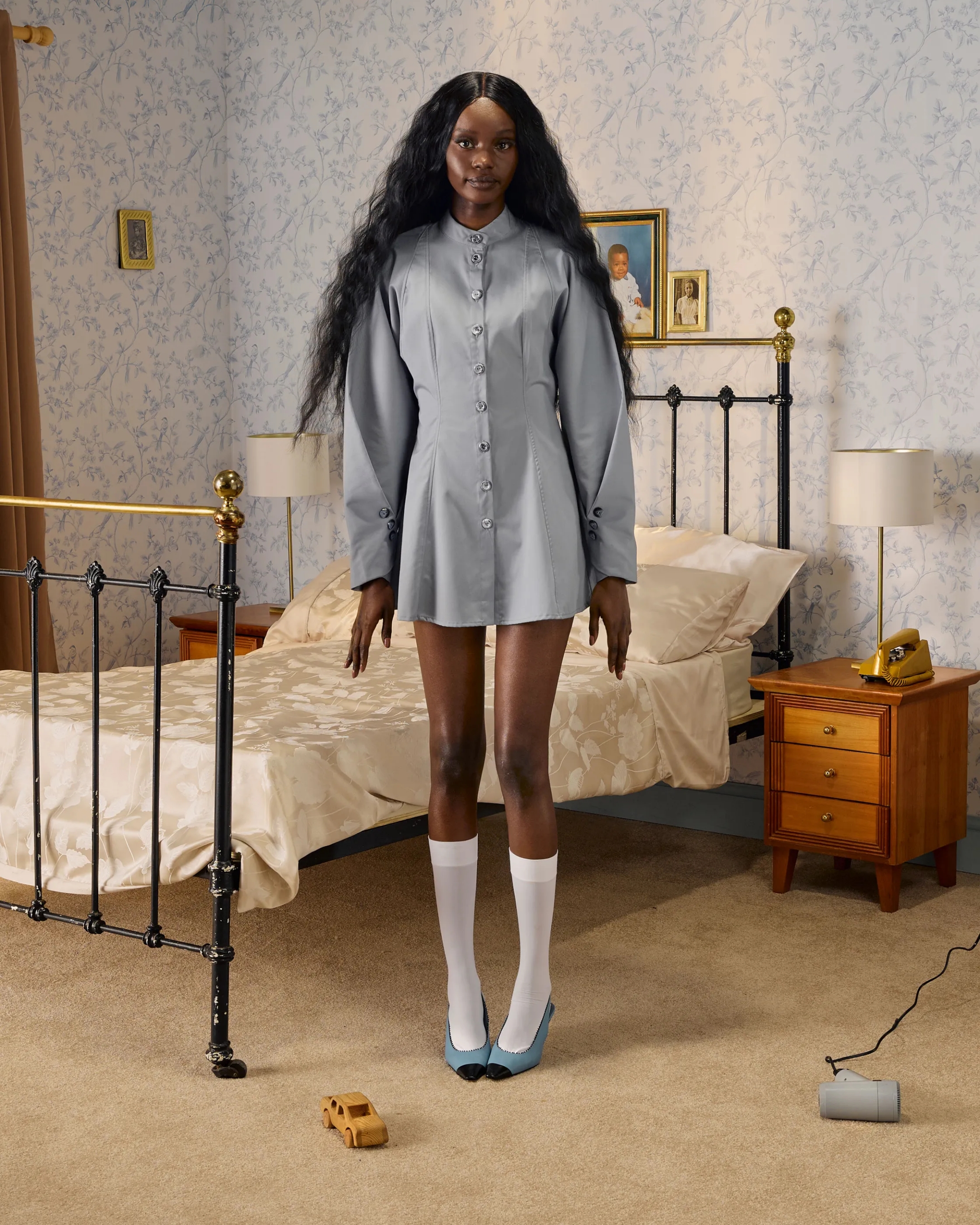
The relationship continued into LABRUM’s Spring/Summer 2025 show, staged pitchside at Emirates Stadium. The collection included the away kit reworked as a tailored suit. Here was a particularly clear link between the two settings: a piece of football clothing had become material for the label’s own fashion proposition.

I like that movement because each setting asks something different of the work. On a football shirt, a graphic has to live with established badges and a familiar shape. On a suit, proportion and cut change how you read it. There is more to discuss than whether the same logo appears in both places. You can follow an idea as it takes on another job.
For a smaller brand considering a collaboration, that is a useful test before agreeing to a brief. Identify what you want to contribute and where it will appear in the finished product. Ask whether you will have enough involvement to make those decisions properly. A large audience is attractive, but it cannot tell you whether the result will express anything recognisable about your work.
LABRUM’s public material lets us trace the design from a club shirt to its own runway. The designer’s contribution remains legible when the setting changes. For anyone commissioning a collaboration, it is a reason to give the creative partner room to make choices you can actually see.


.svg)


.svg)
.svg)